_edited.png)
Cracking the London 11+ Consortium Exam: A Headteacher’s Guide to Strategy Over Anxiety
- David Bell M.Ed., FCCT, FCMI

- 3 days ago
- 6 min read
Updated: 13 hours ago
For parents targeting elite independent girls’ schools in London—such as Godolphin & Latymer, South Hampstead, Channing, and Francis Holland—the London 11+ Consortium Exam is the ultimate gatekeeper.
Because the Consortium operates a unified system, your daughter sits just one test for all 14 member schools. While this mercifully reduces the overall exam burden on a ten-year-old, it heavily amplifies the high-stakes pressure: a single "off day" can impact her entire school shortlist.
Co-developed as a prescription evaluation using the Quest Assessment / Atom Learning framework, this 100-minute digital exam intentionally moves away from rote memorisation. Instead, it tests cognitive elasticity, critical thinking, and rapid problem-solving.
As a former Headteacher with 14 years of senior school leadership, I look at this exam through an institutional lens. Success isn’t about endlessly drilling past papers or subscribing to every revision site available; it’s about understanding the unique logic of the digital test architecture and building the metacognitive agility to handle it. Here is my strategic breakdown of the Consortium blueprint and how I prepare students to conquer it using my "Achievement Without Anxiety" framework.
The London 11+ Consortium Blueprint
The exam lasts exactly 100 minutes (excluding a mandatory 30-minute screen break) and is divided into six distinct, timed modules. Crucially, the test is a hybrid model: the first half is adaptive (the computer adjusts question difficulty in real-time based on live performance), while the second half is non-adaptive.
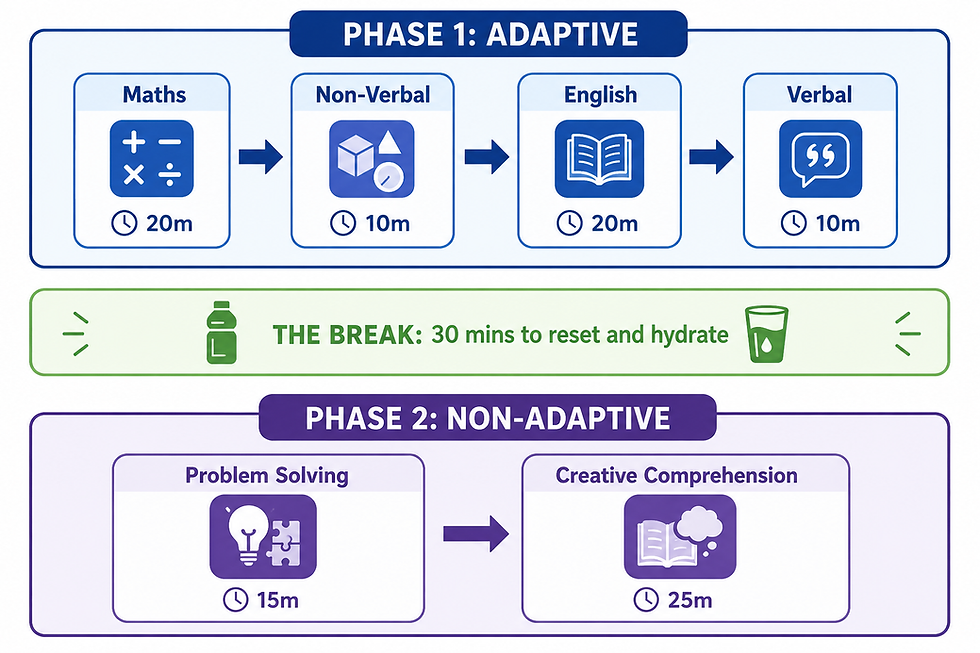
Phase 1: Navigating the Adaptive "Hunting" Algorithm
In the first four modules, the computer algorithm actively "hunts" for your child's learning ceiling. If she answers correctly, the next question gets harder; if she makes an error, the difficulty drops.
Mathematics (20 Mins): The test explicitly restricts content to the Year 5 National Curriculum. You will not see advanced Year 6 algebra. Instead, "stretch and challenge" is achieved through deep, multi-step complexity. Because the algorithm anchors a student’s potential score ceiling based on the first 5 to 10 questions, careless errors made early on out of nerves can artificially cap her maximum score.
Non-Verbal & Verbal Reasoning (10 Mins Each): Rapid-fire modules testing raw cognitive processing speed, spatial logic, and word codes.
English (20 Mins): A bespoke piece of fiction evaluating reading comprehension, spelling, and grammar in context. Note: There is no extended creative writing component in this digital phase.
Phase 2: The Analytical Deep Dive (Non-Adaptive)
After a strict 30-minute screen break designed for a physical and mental reset, the exam switches to a fixed-linear format where the content is completely rotated daily to protect test security.
Problem Solving (15 Mins): Quantitative puzzles requiring candidates to hold multiple logical constraints in their heads at once.
Creative Comprehension (25 Mins): This section routinely catches traditionally tutored children off guard. Instead of a standard text block, your daughter is presented with a vast array of interconnected source materials: maps, timetables, charts, diagrams, and data tables. She must cross-reference information across these different mediums to extract the correct answer.
My "Quest Approach": Overcoming Digital Fatigue
Standard pen-and-paper tutoring is entirely redundant for adaptive digital assessments like the London Consortium. However, the most common mistake I see parents make is over-subscribing to multiple online platforms simultaneously. This inevitably leads to "digital fatigue" and superficial rushing.
My proprietary Quest and Adaptive Prep Approach is built on Master’s level pedagogical research. I use premium digital tools for algorithmic familiarisation and data-driven gap analysis, but I always balance this screen time with the industry's most rigorous physical publications (such as Bond, Galore Park, and Schofield & Sims). This tactile bridge builds true academic resilience, secures the "why" behind mathematical concepts, and protects vital handwriting stamina for the school interview stages.
Balancing the Analytical Mind
Many bright students who are naturally gifted in mathematics can struggle with the deep textual inference and multi-layered data analysis required in the Consortium’s Creative Comprehension phase.
I recently worked with the eldest brother of a three-sibling family I support. He possessed a powerful analytical mind and excelled at raw mathematics, but his English comprehension and inference skills required a targeted overhaul to match that level. Through fast-paced, engaging sessions, I used highly interactive methods to bridge that gap—developing his skills in inference and reading comprehension so his overall ability became perfectly balanced. He went on to pass his 11+ and secure places at both KEGS and New Hall. For the Consortium, I use this exact methodology: teaching students how to treat non-linear texts like infographics or travel itineraries as logic puzzles to be solved.
Moving From Anxious to Strategic
It is incredibly common for highly capable, thoughtful children to become paralyzed by the pace and format of these digital adaptive exams. They begin overthinking questions and struggling with their timings under pressure.
When I coached Niamh through her anxieties surrounding the pace and format of her FSCE 11+ exam for Chelmsford County High School (CCHS), she was experiencing these exact barriers. By "slowing the process down" and rebuilding her strategic lens, I moved her from an anxious mindset to an empowered, tactical one. Niamh ultimately achieved an offer in Band 1—the highest possible band—at CCHS.
While the FSCE and the London Consortium are entirely different exam frameworks, the psychological rule remains identical: when bright children learn to self-regulate, accept that an adaptive test should feel challenging, and use structured problem-solving tools under timed conditions, their natural potential is unlocked.
The Headteacher's Interview Verdict
It is vital to remember that the London Consortium test is only the initial filtering mechanism. The ultimate admissions decision almost always hinges on the face-to-face interview.
In my years sitting on the other side of the independent school admissions desk, I have seen countless over-coached, rehearsed candidates rejected. Highly selective schools actively screen out robotic answers. They are looking for presentation, executive communication, and authentic curiosity.
When working with global or high-achieving London students—such as Sebastian, who navigated a highly competitive admissions process to secure multiple top-tier independent offers and is now thriving at Emanuel School—I focus heavily on presentation coaching. Sebastian was exceptionally bright in Maths, but needed to learn how to articulate his complex, high-level ideas with clarity and confidence during the interview process. Whether your child faces a formal panel interview or a collaborative group activity, they must know how to project their true personality without letting anxiety mask their capability.
Mapping Your Daughter's Pathway
The London Consortium exam cannot be out-smarted by memorising question types. The Quest algorithm is designed to find your child's natural learning ceiling, and the final sections are explicitly built to test how she thinks under pressure.
If you are beginning to plan your daughter's Year 5 or Year 6 timeline for the London independent market, success starts with a clear, objective understanding of her current foundations. Through my 90-minute Headteacher-led Academic Audit, I look beyond the raw percentages to identify the hidden barriers—whether they are structural mathematical blind spots or performance-based anxieties—and build a bespoke, stress-free roadmap to the exam room.
If you want to see a breakdown of the specific digital platforms I recommend for balancing a child's learning ceiling, take a look at my 11+ free resources guide.
Further Reading & Target Schools
If you are currently shortlisting schools for your daughter’s 11+ transition, it is essential to review the specific admissions policies and open-day schedules for each individual member school. While they share a singular entrance examination, each institution weights the interview, academic references, and final scores differently.
The Official Exam Portal
The London 11+ Consortium Official Website: Access official familiarisation materials, policy updates, and registration guidelines for the sittings.
The Member Schools
North & West London
Channing School (Highgate): Known for its strong arts and academic balance in Highgate Village.
South Hampstead High School (GDST): Highly selective, with a focus on deep academic engagement and progressive learning.
Godolphin and Latymer School (Hammersmith): Exceptionally high academic standards, utilising the assessment score as an interview filter.
Notting Hill & Ealing High School (GDST): Renowned for scientific excellence and exceptional pastoral care.
Central & South West London
Francis Holland School (Regent's Park): Academically rigorous with a selective interview process based on test outcomes.
Francis Holland School (Sloane Square): Fosters creative problem-solving and entrepreneurial thinking.
Queen's College, London (Marylebone): The first school in the UK to grant academic qualifications to young women.
Queen's Gate School (South Kensington): Offers a supportive, holistic educational environment in the heart of London.
More House School (Knightsbridge): A small, nurturing, and highly focused environment emphasising individual attention.
Greater London & Outer Boroughs
St Augustine’s Priory (Ealing): Set in 13 acres of grounds, combining traditional values with forward-thinking digital assessment integration.
St Helen’s School London (Northwood): Promotes exceptional quantitative and non-verbal spatial development.
Northwood College for Girls (GDST): Focuses deeply on building student cognitive flexibility and confidence.
St James Senior Girls’ School (Olympia): Blends strong academic results with philosophical and spiritual development.
St Margaret’s School (Hampstead): Dedicated to small-class excellence and a tailored approach to senior transitions.
Why the Right Strategy Matters Across the Board
Whether your focus is the creative culture of Channing, the mathematical rigour of Godolphin and Latymer, or the holistic community at St Augustine's Priory, your child's preparation must be uniform in its strategy.
To talk through how my Quest Approach can transform your daughter’s digital test scores—or to arrange an Academic Audit ahead of the registration closing dates—contact me directly today.


![Preparing Your Child for Secondary School Interviews: A Comprehensive Guide [Updated for 2026]](https://static.wixstatic.com/media/11062b_3afd079ec52a40a7b32e482208f1e0c8~mv2.jpg/v1/fill/w_980,h_653,al_c,q_85,usm_0.66_1.00_0.01,enc_avif,quality_auto/11062b_3afd079ec52a40a7b32e482208f1e0c8~mv2.jpg)
Comments